She told me about the book "Younger Next Year" that she and Tony have learned from. The idea is to stay in the shape that you are from age 50 on through your 80's, or even to recover being in better shape than when you start. I have read it and am now working more on my fitness. One ray of hope - Sheryl Van Fleet who wrote "The Recumbent and the Upright" said that long rides on her recumbent bike fixed her knee problems. So maybe I'll be able to do more than I thought.
Wednesday, November 23, 2011
Half Marathon
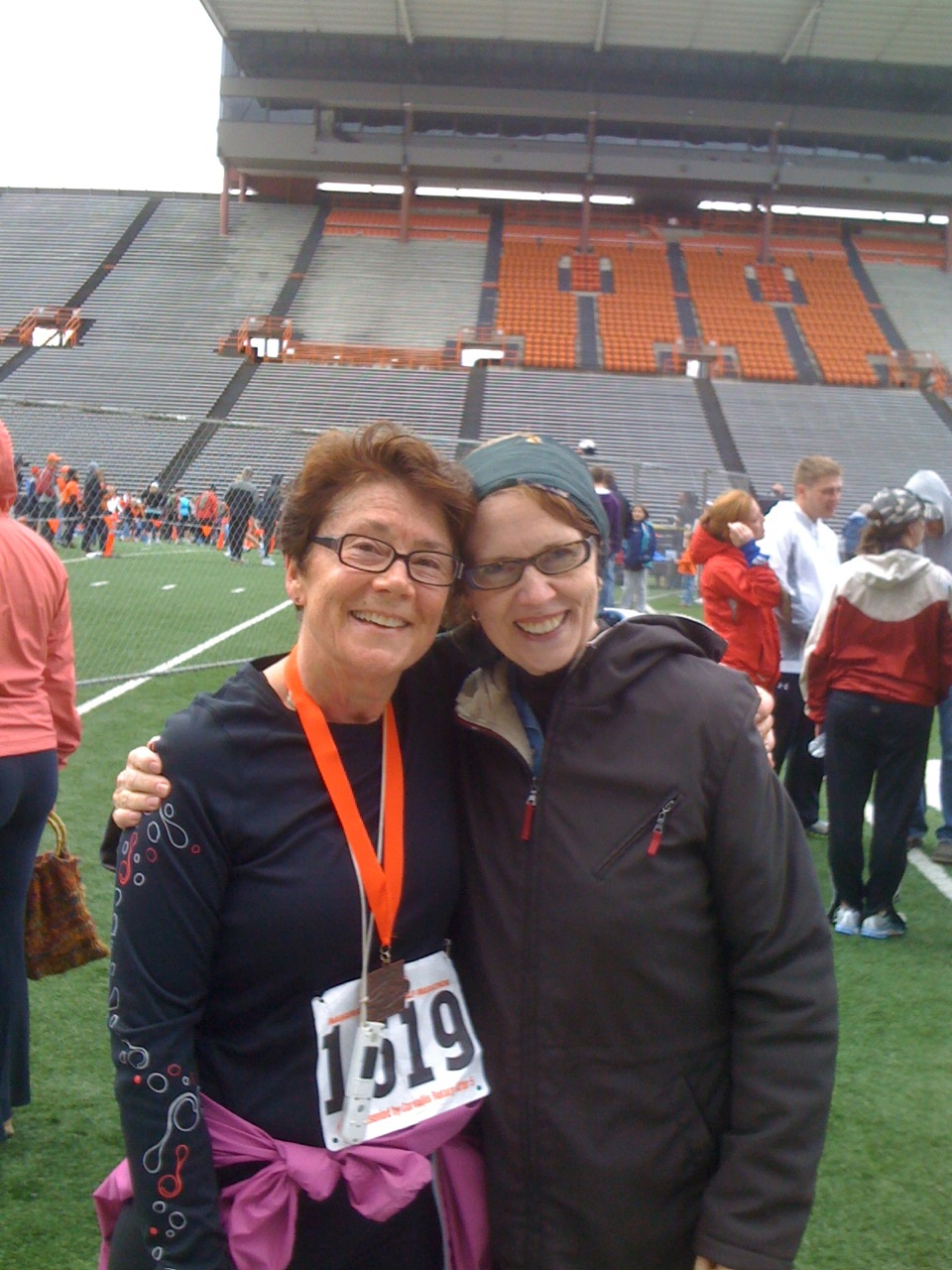
Corvallis hosted it's first ever half marathon run and walk. I was surprised when my sister Debbie said she was going to train for, and plan to do a run/walk for this half marathon. Didn't she realize she is over 60 (older than me!) and has never done anything like this? I was afraid that she was sure to injure herself. I used to run short races, and then walked Hood to Coast a couple of times, and was convinced for myself that I could not do that any more. I felt problems in my knees when I tried to walk briskly for too long. Anyway, she trained according to a book, and she MADE IT! I was at the finish line and I was so very proud of her.
She told me about the book "Younger Next Year" that she and Tony have learned from. The idea is to stay in the shape that you are from age 50 on through your 80's, or even to recover being in better shape than when you start. I have read it and am now working more on my fitness. One ray of hope - Sheryl Van Fleet who wrote "The Recumbent and the Upright" said that long rides on her recumbent bike fixed her knee problems. So maybe I'll be able to do more than I thought.
Mennonite Village
In September we moved our 91 year old mother to Mennonite Village, in Albany. We will not sell or even clear out her house until she is ready. Of course it wasn't easy for her to give up on the idea of living in her own home, but she has had some falls that caused her doctor to say that she cannot live by herself.
We chose this facility based on recommendations of people who are familiar with facilities in this area. Our mother is in assisted living, but they also have independent living, rehab, and long term care. It feels good to know that whatever her needs they will be able to care for her. I keep telling her to be grateful that she isn't in long term care, her quality of life is good with attractive facility, a room to herself, a kitchenette, carpeted floor, fun activities, good food, etc.
Debbie and I both live about a half hour away. For Pam it is closer to 2 hours. So she visits just once a week, for a longer visit. Debbie and I have been going 2 or 3 times a week. Of course there have been a few wrinkles to iron out, but we are overall impressed with the staff. The woman in charge of activities is especially wonderful, she has worked hard to include our mother in all activities including exercise, music performances, wii games, etc. For Halloween they brought out a number of hats for residents to have fun with. Mother picked out a fun Christian Dior hat.
Another particularly wonderful aide seems to enjoy styling her long hair. Our mother insisted we get a purple hair extension for her, as she saw one on an aide at the hospital. We did, and the Mennonite Village aide will weave it in with her braid, making her look artistic. She has also brought in, at her own expense, styling gel and clips to do up her hair.
We have been getting to know some of the other residents, and are starting to feel like we're part of the Mennonite Village family. I am already fond of a number of the others. Mother sits with different people at each meal, and there is usually some interesting conversation. Our mother is frequently the one that gets conversations going.
I am so grateful that I have my sisters, it is great to share looking out for her amongst the 3 of us. And grateful we always come to agreement on any issues relating to our mother.
Fourth of July party
Gary has an annual fourth of July party. I arranged for a group Nick plays with, "Rocket Stove Workshop" to perform, which added to the fun. The music was a funky New Orleans style. We barbequed, and everyone brought side dishes for a fabulous spread. Activities included croquet, kicking soccer ball around, and putting on the golf green.
I was so happy that friends of my own came. Vesna and Burke and their families, who I met at exercise classes. Becky and Ligaya and their families, from work. Consuelo and Tom, old friends, came from Salem. Dan and Diana Breen, plus Jill Hibbs drove down from Tigard. My sisters came, which made me really happy. And new-old friends Bryon and Sheryl Van Fleet who recently moved to Corvallis. It was great.
The most patriotic dishes brought were by two who are not native to the USA. Burke, from Australia, brought a scrumptious red, white and blue trifle. Vesna, originally from Croatia, brought a huge platter of strawberries dipped in white chocolate with blue sprinkles on them. I pretty much ate those instead of anything else.
We three sisters in our dad's hats
Da Vinci Days
One place I spent a lot of time was Greentown - a place with from many ecological organizations. I learned so much! I had no idea there were so many non profits as well as government agencies doing interesting work related to the environment.
There were also music concerts, and I loved seeing Bobby McFerrin and the Yellowjackets. Really great straight ahead jazz that did my heart a lot of good.
I will include a number of my photos.
Tuesday, August 16, 2011
Combine Ride
I was busy in the kitchen, cooking carrots that I had grown with butter and basil, also from the garden. Gary walked in and said "I made arrangements for you to ride on a combine." I can't say I was happy about this - he made arrangements for me to do something I hadn't thought about wanting to do. But he knows I'm interested in all that goes on around her, so he was right to think I'd be interested in the combine. There was work being done on the field behind his property, I was just a little wary about who the people might be running the machines, whether I was really welcome, and the unknown of what it would be like.
It helped that the driver and maintainer of the combine was a 20 year old girl, named Mercedes. I liked her right away, so I knew it would be ok. I am impressed that she has been doing this for 5 years, and she services her own machine, owned by the people who own the crop (but not the land). Here she is:
It turned out to be quite comfortable. The cab was clean, enclosed, and air conditioned. She said it was like driving a big house around. Not unlike a car, you go forward, backward, turn, etc. Hers goes 3.5 mph which is faster than another one that was on the field.
Mercedes described the process for me. First the field is cut. Then a machine called a "swather" comes through and rakes it into rows - hence the expression "cutting a wide swath". Her machine drives over the row, and pulls it up and separates the seed from the straw. So it seems misnamed to me - it isn't combining anything, but rather separating. The seeds go into the hopper in the combine, and straw is left on the ground. When the hopper is full she dumps it into the truck sitting there for that purpose.
This field was harvesting rye seeds. She said more lucrative crops are "meadowfoam" which has seeds that are used in cosmetics. They contain an oil which stays on the skin better than some other oils. The plant looks soft from a distance, hence the name, but she said it isn't really soft. Another more lucrative product is "oilseed radish" which creates a cover crop that restores soil. She said there is a big market for it in Central America.
She told me that after her work is done, the straw is either plowed back into the soil, or it is baled up for other purposes.
I had a lot of fun asking her questions and hearing about what is ahead for her. Her husband is in the military and they are heading for Korea soon.
Thanks to Gary for making this possible for me.
Wednesday, July 13, 2011
Cherry Picking
I have never been excited about radishes, so I won't count them as the first thing we harvested this summer. But I couldn't help but be excited about the tree beautifully adorned with pie cherries. We picked a bit more than 4 quarts yesterday, pitted them, and put them in freezer bags to save for pies for later.
Gary had told me that he would not be getting on the ladder to pick cherries, that I could do that. He said his doctor told him not to get on a ladder again, as he had had a fall a few years back and injured himself. I was curious whether the reason was the unsteadiness of being on a ladder, or whether it had to do with physical condition, so I asked him what the doctor said about it. He said "The doctor said it is stupid for anyone over 60 to get on a ladder." I could see as he was saying it that he was realizing he was telling me I should do something the doctor said would be stupid, as I am 62 years old. So - he didn't want to injure himself but it was OK for me to take a chance? I hope it was because he perceived that I am in good physical condition and less likely to lose my balance, rather than he cared more about hurting himself than me hurting myself. Ha, ha.
Anyway, we did pick cherries and it will be fun to make pies with them later. For now I just love looking at them.
Monday, July 4, 2011
The Drama of Hay
I first had a clue about the drama of hay, talking with my friend nurse Sandy at the Benedictine Nursing Center. She has 5 horses. She told me there is a short window where hay is available at a reasonable price, and she has to be on her toes with phone available at all times, to arrange for hay for the winter for her animals, or she'll lose it to someone else. If you don't get hay during this period it would be prohibitively expensive later.
Now I have seen the other side. Gary has 10 acres, and he grows hay on 7 of it. The biggest part of the drama is weather during the haying season. "Make hay while the sun shines" is no joke. If it rains during the process, you can lose the whole crop.
Here is how it goes. First the hay is cut. It needs to dry out a bit, so it sits for a couple of days, then it needs to be turned. A tractor with a particular implement turns the hay. Then a couple of days later, the tractor combines each two rows into one, making fewer passes for the baler. Next, the baler comes, and it is an amazing thing to watch - it travels along, taking in hay, and turn out bales from it's back end. You can't help but think of it as eating up the hay and passing it like, well, you know.
Gary was on pins and needles yesterday during the baling. His friend Fran wants 350 bales and the rest will go to neighbor Harold who has 10 horses. Gary and Kelly combine their crops for this sale. Kelly doesn't have as many acres in hay, because part of his is planted in evergreen trees that sometime after his lifetime would be harvested.
Gary normally would have about 435 bales, but this year because of weather only had 335. His expenses are rising, with fuel and fertilizer, so price needs to go up. Last year he charged $120/bale. This year to break even he would have to charge $130/bale or to make a little profit (very little, for all the trouble), he would need to charge $140/bale.
The next really important step is for the hay to get moved and under shelter, to protect from weather. If the customer does this, Gary can charge less than if he had to get his work done and figure out where to put it. At this moment the bales are sitting in the field waiting to get picked up. Next bit of drama, will Fran and Harold accept the higher price? If not, how to find other customers?
It is a sketchy business, because Gary needs someone else to do the tractor and baling work. It is hard to find people willing to come work on a small 7 acre operation. His friend Dennis does it, just because he is a friend. His wife, the lovely Geri Ann, is the one who provides eggs for us from her chickens. I am impressed with what a community there is here, how connected everyone is and must be.
Here are photos:
Subscribe to:
Posts (Atom)